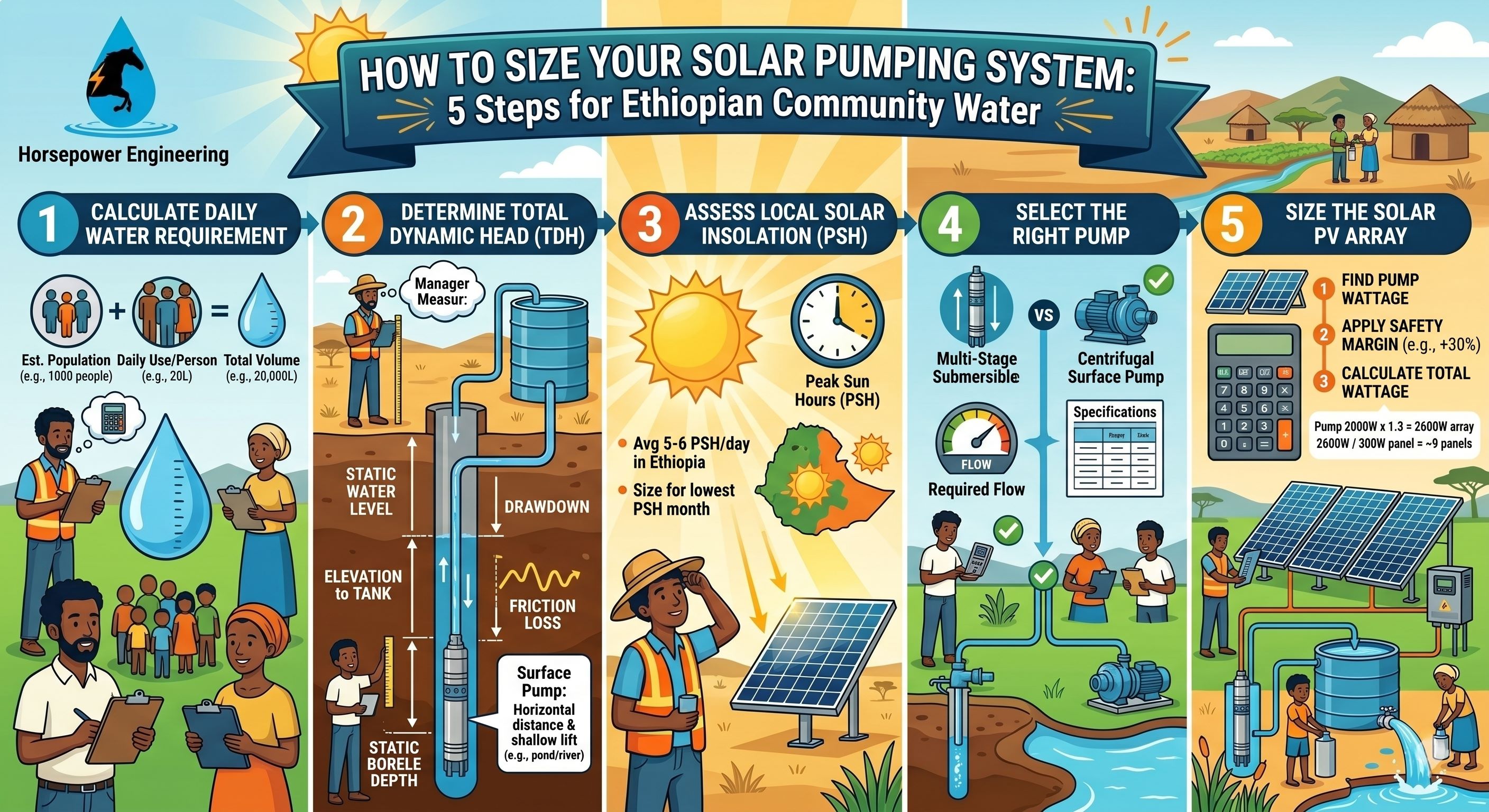
Here is a step-by-step guide to calculating your water needs, determining your pump size, and sizing your solar PV array for Ethiopian community water projects.
Step 1: Calculate the Daily Water Requirement
The foundation of any solar pump design is knowing exactly how much water the community needs per day. Oversizing leads to wasted money, while undersizing leads to water shortages.
- Establish a baseline: Determine the population size of the community.
- Estimate daily consumption: A standard rural planning metric is often between 15 to 25 liters per person per day, depending on local guidelines and livestock needs.
- Calculate the total volume: Multiply the population by the daily requirement. For a community of 1,000 people, needing 20 liters per day, your target volume is 20,000 liters (20 cubic meters) per day.
Step 2: Determine the Total Dynamic Head (TDH)
The "head" is the total resistance the pump must overcome to move the water from the source to the destination. Because many Ethiopian projects rely on deep wells, calculating the TDH accurately is critical for sizing submersible pumps.
TDH is calculated by adding the following:
- Static Water Level: The distance from the ground surface to the water in the well before pumping begins.
- Drawdown: How far the water level drops while the pump is actively running.
- Elevation to the Tank: The vertical distance from the ground level to the top of your water storage tank.
- Friction Loss: The pressure lost as water travels through the pipes and fittings.
Note for Surface Pumps: If you are using a centrifugal surface pump for a shallow community water source, your TDH will focus more on the horizontal distance and the vertical lift to the community reservoir rather than extreme well depths.
Step 3: Assess Local Solar Insolation
Solar pumps don't run 24/7; they operate during "Peak Sun Hours" (PSH). A peak sun hour is not just any daylight hour, but an hour where solar irradiance reaches 1,000 watts per square meter.
- Ethiopia boasts excellent solar resources, typically averaging 5 to 6 Peak Sun Hours per day depending on the region and season.
- To ensure the community has water year-round, always size your system based on the lowest average PSH month (usually during the rainy season).
Step 4: Select the Right Pump
Now that you know your daily volume and your TDH, you can select a pump. You must find a pump capable of delivering your target volume within your available Peak Sun Hours.
- For Deep Wells: You will need a multi-stage submersible pump. These are engineered to push water up from significant depths.
- For Shallow Sources/Rivers: A surface (centrifugal) pump is ideal.
- Divide your daily requirement (20,000 liters) by your Peak Sun Hours (5 hours) to get your required flow rate: 4,000 liters per hour.
Step 5: Size the Solar PV Array
The solar panels are the engine of your system. To determine how many panels you need, you must look at the power rating of your selected pump.
- Find the Pump's Wattage: Check the manufacturer's specifications for the required power (in watts or kW) to achieve your specific flow and head.
- Apply a Safety Margin: Solar panels rarely operate at 100% efficiency due to heat, dust, and wiring losses. In the Ethiopian climate, panel temperatures can rise, which slightly lowers their output. It is an industry standard to oversize the solar array by 25% to 30% above the pump's required wattage.
- Calculate Total Wattage: If your pump requires 2,000W, multiply by 1.3 to get a target array size of 2,600W. If you are using 300W panels, you will need approximately 9 panels to power the system reliably.
By following these exact steps, you ensure that the water system is resilient, efficient, and perfectly tailored to the community it serves.